
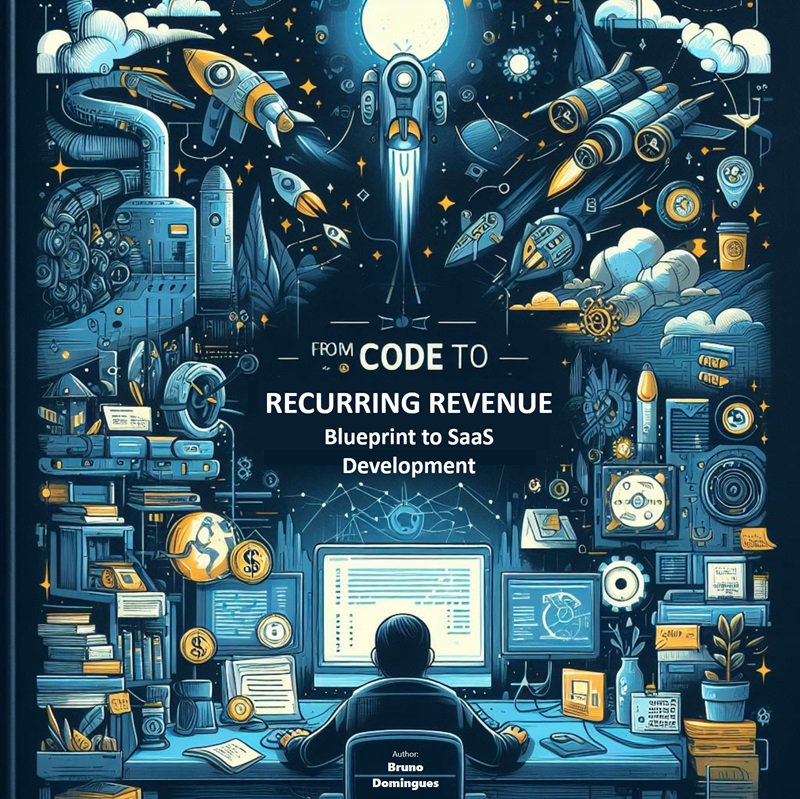
From Code to Recurring Revenue
Blueprint to SaaS Development
My first time writing with AI. I wanted something I’d actually buy myself — a practical guide for building a SaaS, written from the developer’s seat. The process taught me a lot, including the value of having a dedicated system for tracking feature ideas.
The book I wish I’d had when I started.
I’d been building SaaS for a decade and kept seeing the same mistakes — founders who could write the code but couldn’t find a customer; founders who could find customers but couldn’t price; founders who got both right and quit at the boring middle. None of the SaaS books I’d read addressed all three from a developer’s seat.
So I wrote one. Short, opinionated, no consultant fluff. It’s the book I wish someone had handed me when I started Multiuniversal in 2004 — or, more usefully, when I started building my social CRM in 2016 and spent two years learning a lesson the book’s Chapter 5 now compresses into thirty pages.
Developers thinking about going independent. And the people they’re building with.
- Developers thinking about going independent — or already independent and stuck.
- Non-technical founders working with a developer who want to understand the same map.
- Anyone in year one or two of a SaaS who suspects they’re making mistakes but doesn’t know which.
- Engineers at a SaaS company who’d like to understand the business side without sitting through an MBA.
VC-backed founders chasing hypergrowth.
There are better books for that — The Hard Thing About Hard Things, Blitzscaling, anything by First Round. This book assumes you’d like to build something profitable on your own terms, slowly, in a way you can sustain. If your plan involves raising a Series A in eighteen months, the framing won’t match.
Also probably not the right book if you’ve already shipped three SaaS products and run a sales team of ten. You’re past it.
CHAPTER 3 - From Idea to MVP: Prototyping Your SaaS Product
“In the middle of difficulty lies opportunity.” — Albert Einstein
Diving into the SaaS world isn’t a walk in the park. Remember when you had that lightbulb moment, that brilliant idea? Turning that into something real — that’s where the fun begins! In this chapter, we’re gonna break down the whole process.
For all my dev buddies out there, a piece of friendly advice: take it step by step. Start simple, then build from there. Think of it like making a pizza — you start with the basics and then add in more as you go. And always, always test your stuff. Get some feedback, tweak it a bit, and make it even better. By the end, you’ll have something you’re proud of and that people will love. Alright, let’s get into it!
Ideation: Identifying Pain Points & Market Gaps
You know those little annoyances that pop up in daily life? Those are golden opportunities. Seriously, the best ideas often come from regular day-to-day problems. Keep an ear out. When people grumble, vent, or wish things were different, there’s probably something there. It’s like a little hint saying, “Hey, there’s a gap here waiting for a solution.”
When I built my own SEO tool, it was to solve a daily hassle of having to do a bunch of repetitive tasks every week in order to measure current page ranking for multiple pages.
Later on when I built my own Chat Management tool, again it was to solve the hassle of using Google Sheets to track hundreds of conversations with potential clients. I was spending 16h a day on social media, even though I was netting $100k in a month, it led to inconsistent sales months until I built the tool to make it much much easier and much much faster.
For developers reading this, remember, don’t just jump on any problem. Think about what you’re good at, your strengths. Maybe you’re great with databases, or you’ve got a knack for user experience. Match that skill with a problem you’ve noticed. And hey, don’t be scared to ask folks — friends, family, even strangers — about what bothers them. You’d be surprised how much insight a simple chat can give you.
Chapters
-
00
INTRODUCTION - SaaS Simplified: A Coder’s Perspective
Frames the book as a seasoned coder’s diary — from ZX Spectrum and Turbo Pascal to PHP/MySQL and the SaaS world, written as jargon-free practical advice for developers curious about building SaaS.
-
01
CHAPTER 1 - The Developer’s Edge in SaaS
Argues developers have a built-in advantage in SaaS because the product is software. Traces my own arc from a Portuguese teenager freelancing to entrepreneur in London, framing problem-solving and a coder’s mindset as transferable.
-
02
CHAPTER 2 - Foundations: Understanding the SaaS Landscape
A primer on what SaaS is, market dynamics, the major and niche players (Salesforce, AWS, Slack, Stripe, Shopify), and a brief history from 1960s time-sharing through ASPs in the ’90s to today’s subscription era.
-
03
CHAPTER 3 - From Idea to MVP: Prototyping Your SaaS Product
Turning a lightbulb moment into something real: spotting pain points, customer interviews, surveys, then sketching, wireframing, user journeys, and clickable prototypes in Figma or Sketch before writing production code.
-
04
CHAPTER 4 - The Business of Code: Transitioning from Developer to Entrepreneur
On switching from playing guitar alone to running a band — picking up basic business skills, surrounding yourself with non-developers (marketers, designers, salespeople), embracing failure, and cultivating a growth mindset.
-
05
CHAPTER 5 - Market Fit & Validation: Does Your SaaS Solve a Problem?
Pushes back on “build it and they will come.” You have to talk to potential customers first, ship a small prototype, stay flexible, watch competitors, and see if anyone will actually pay before you scale.
-
06
CHAPTER 6 - Monetizing Your SaaS: Pricing and Revenue Models
Compares subscription, freemium, and tiered pricing using Dropbox, Slack, Zoom, HubSpot, Mailchimp, Salesforce, Shopify, and AWS, and explains how to anchor price to perceived value using tools like ProfitWell.
-
07
CHAPTER 7 - Marketing for Developers: Gaining Your First Customers
Marketing translated into developer terms — the 4 Ps reframed, listening before shouting, organic growth via blogging and community engagement on Stack Overflow and GitHub, then amplifying with PPC and retargeting.
-
08
CHAPTER 8 - Scaling Strategies: Growing Beyond the Initial Phase
When to grow the team (volume, innovation stagnation, burnout, expertise gaps), and how to hire strategically — the jigsaw puzzle approach, attitude over skills, trialling freelancers first, with examples from Slack, Atlassian, HubSpot, and Buffer.
-
09
CHAPTER 9 - Customer Relations: Support, Feedback, and Retention
Treats customers as part of the SaaS family: fast response times, multi-channel support, knowledge bases, follow-ups, training support staff on soft skills, and building feedback loops to drive product improvement.
-
10
CHAPTER 10 - Staying Ahead: Continuous Innovation in SaaS
Frames innovation as a survival skill in a low-barrier-to-entry market with tech-savvy users. Surveys emerging trends (IoT, quantum, 5G) and how to weave them into a SaaS without chasing every shiny thing.
-
11
CHAPTER 11 - Facing Challenges: Overcoming Common SaaS Obstacles
A practical tour of common founder problems — bugs and glitches (feedback loops, triage, version control, bug-review meetings), scalability, and security — framed as stepping stones rather than roadblocks.
-
12
CHAPTER 12 - From Here to SaaS Supremacy
A reflective recap of the journey from idea through development, pricing, marketing, scaling, and innovation. Frames “supremacy” as long-term impact and standard-setting rather than just revenue.
-
13
CONCLUSION - From Code to Recurring REVENUE
Closes on the developer-turned-entrepreneur dual identity and the never-ending SaaS odyssey, with concrete action items around staying curious — communities, webinars, exploring adjacent fields.